
原帖发布于
【the only seo audit you'll ever need (thank you jev)】
Every AI SEO audit I have read sounds certain about everything.
Jev SEO is the first one I have seen that tells you exactly how sure it is. It is free, it is open source, and it runs as a skill inside Claude Code.
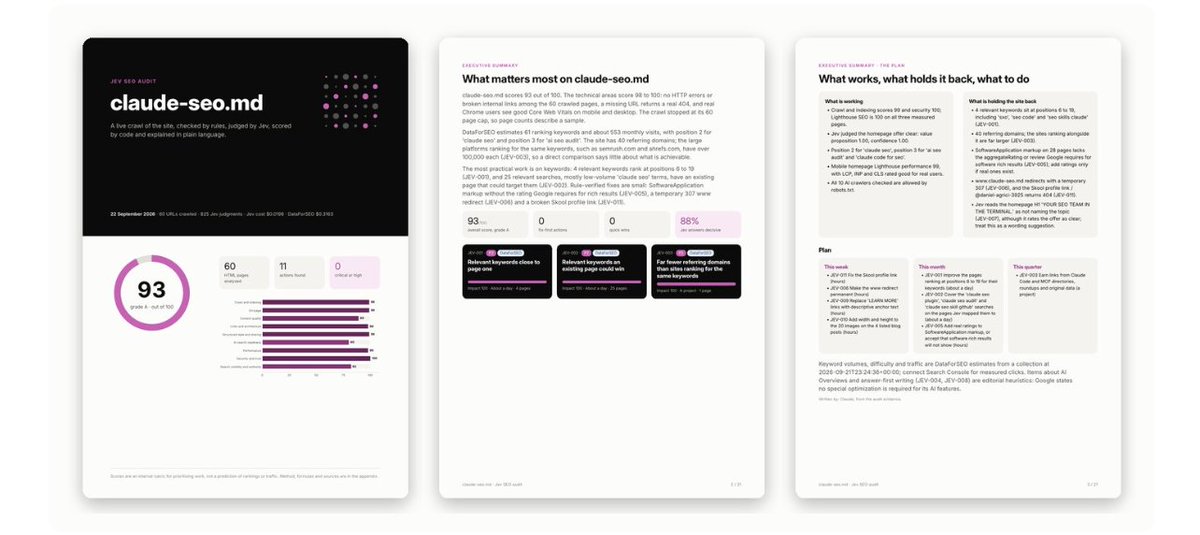
Daniel Agrici built it and walked through it on his channel, AI Marketing Hub. You give it one homepage URL. Five minutes later you have a designed PDF, an Excel tracker and a markdown report, all built from the same audit file.
The part worth your attention is not the PDF. It is who is allowed to decide what.
1. Sources find, code decides, Jev judges, Claude writes
The reason AI audits make things up is that one model does every job at once.
It crawls, it measures, it interprets, it writes the summary. So when it does not know your LCP, it guesses one that sounds plausible.
Jev SEO splits the work into four roles, and none of them can do the others' job.
Sources find. A live crawl of the site, Google PageSpeed Insights for Lighthouse scores and real Chrome user data, and optionally DataForSEO for rankings, keywords and backlinks.
Code decides. Status codes, duplicates, schema parsing, 52 rules tied to Google Search Central, the scoring formulas. Everything that can be counted is counted by code, never by a model.
Jev judges. Jev is TypeSafe's new model, and it is not a chat model. It answers typed questions with probabilities. Page type, search intent, helpfulness, specificity, trust, citability, whether the title and meta fit the page, which two pages compete for the same query.
Claude writes. The summary and the plan, citing action IDs from the audit. The repo refuses any action ID that does not exist and flags any number in the summary that is not in the audit.
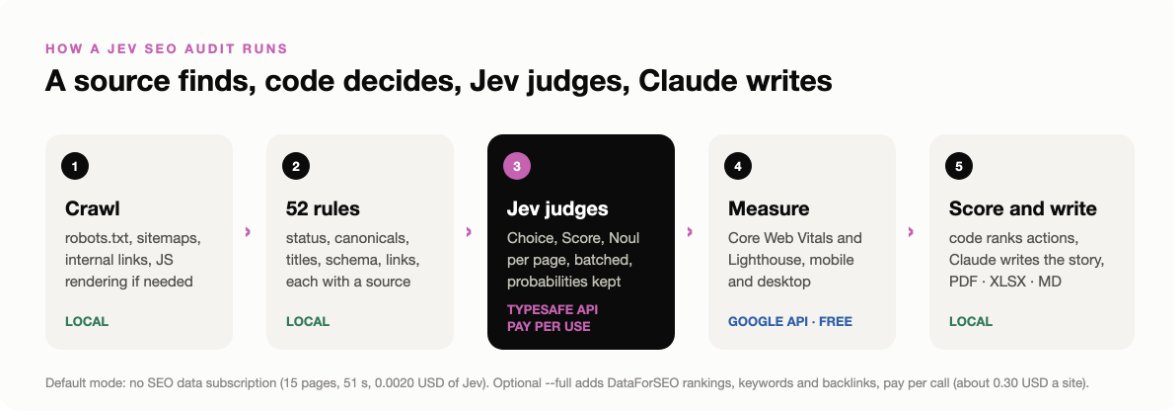
-> The writer is the only part that can hallucinate, and it is fenced in by the other three.
Jev never predicts rankings or traffic. It never invents data. That is not a disclaimer, it is how the pipeline is built.
The cost is the other surprise. About one cent of Jev per site. Around $0.30 more if you add DataForSEO with the --full flag.
2. The confidence score is the feature
A yes/no audit is useless when it is wrong, because you cannot tell which answers are the wrong ones.
Jev returns a probability with every answer. The skill sorts them into bands. Decisive answers go into the report as findings. Anything outside the decisive band is flagged "to verify" in the PDF, the Excel file and the markdown.
So the report tells you which of its own lines to double check.
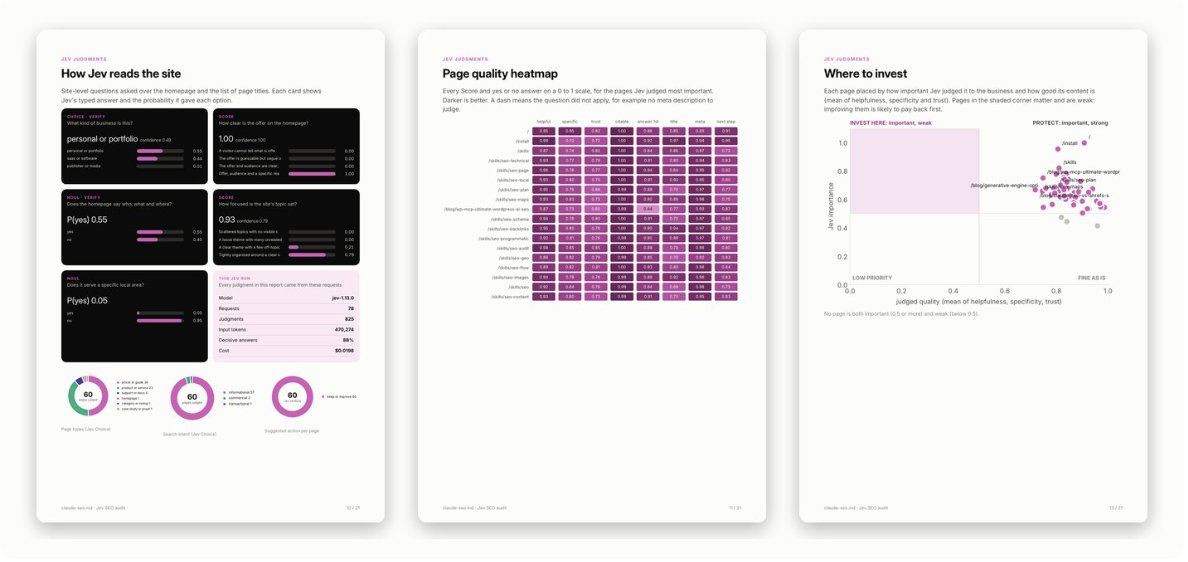
Daniel measured how stable that is. Same 59 pages, judged twice. Page type came back identical on 58 of them. When Jev was decisive both times, it agreed with itself 44 out of 44.
He also checked the rule layer against reality: PageSpeed Insights re-run fresh, the live site re-fetched, Search Console compared by hand. His words, not mine: "full on accurate".
3. What it finds on a site that already scores 93
The demo ran on claude-seo.md, Daniel's own site. Overall grade: 93 out of 100. Nine areas scored, crawl and indexing to AI search readiness.
A 93 still produced eleven ranked actions. The useful ones:
• - Keywords sitting just off page one. "sxo" at position 18, 720 searches a month, difficulty 0.
• - 25 relevant keywords an existing page could win, each mapped to the page that should target it.
• - Structured data missing the properties Google needs for rich results, on 28 pages.
• - Internal links whose anchor text is "LEARN MORE".
• - Four blog posts where Jev scored "opens with the point" at 0.42 out of 1. They bury the answer.
• - 40 referring domains, against a median of 101,083 for the sites ranking on the same keywords.
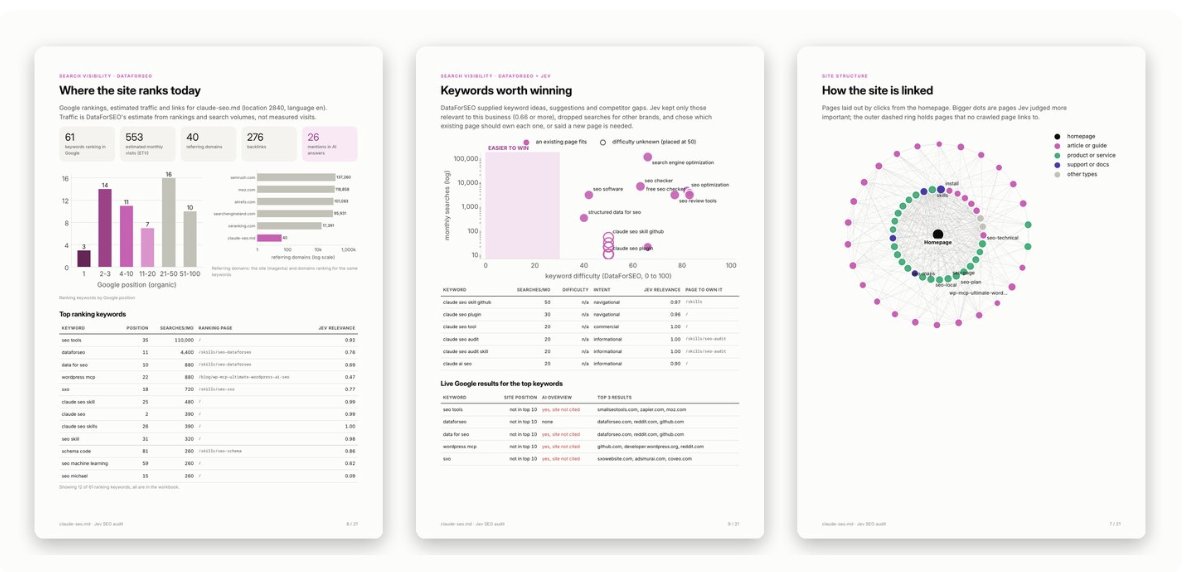
That last line is the honest kind of finding. The audit can see the gap. Nothing in a crawl can close it.
4. It tried to delete posts that were fine
This is in Daniel's own evaluation file, which is why I trust the rest of it.
One of the Jev questions asks what to do with each page. Twice, it suggested removing substantial posts.
Not thin pages. Real articles.
The fix was not a better prompt. It was a line of code: removal is now blocked for any page of 600 words or more, whatever the model says.
That is the rule worth stealing even if you never install the skill -> never let a probability model make an irreversible call. Let it rank. Let code hold the veto.
Page type is the other weak spot. Against a second, blind judge, Jev agreed on page type 20 times out of 30. All ten disagreements were the same confusion: docs page or product page.
5. An audit is a to-do list. Someone still has to do it.
Here is what Jev SEO does not do, and the README says it plainly: it is an evidence tool. It does not track rankings, it does not measure traffic over time, and it does not touch your site.
You finish with eleven action IDs and an Excel tracker with a status dropdown.
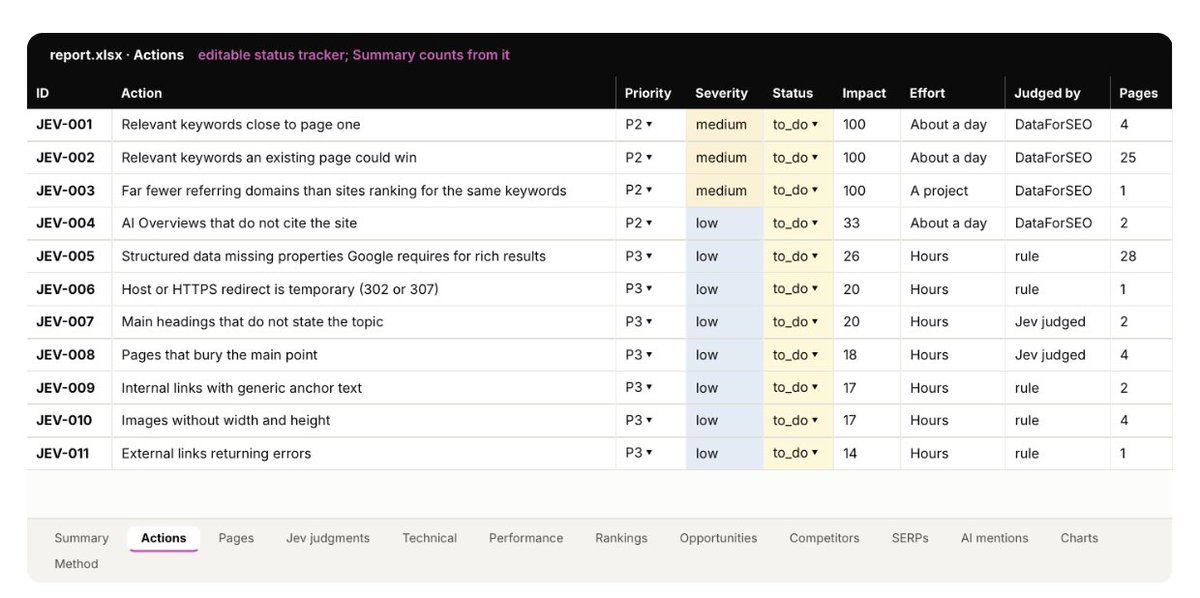
Every status column says to_do. The audit is finished. Nothing on the site has changed.
Then the real work starts. Rewrite the four posts so they answer first. Build the page for the keyword at position 18. Fix 28 schema blocks. Find out whether the "to verify" lines were right.
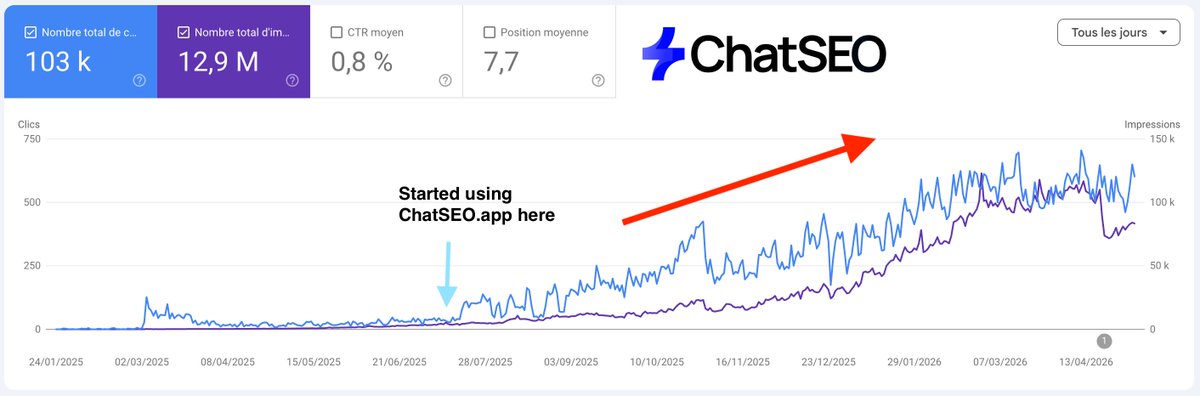
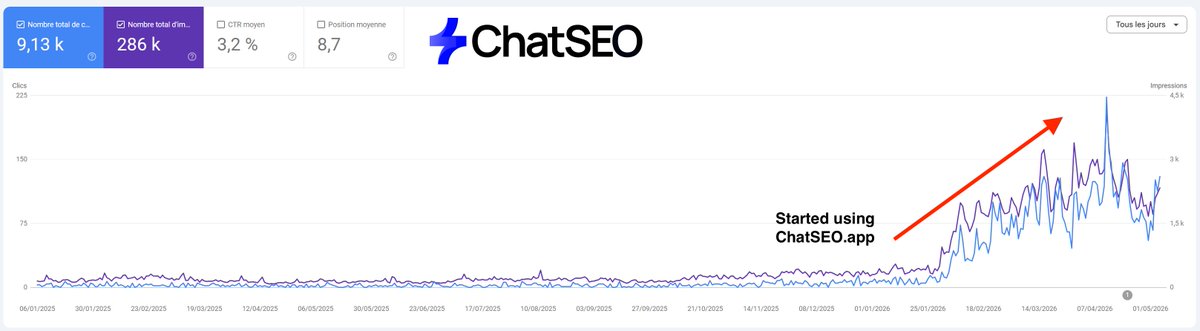
That is where we built ChatSEO.
Connect your Search Console, then paste the audit and ask: which of these actions matter for my traffic, and do them in order. It checks each finding against your real clicks and impressions, tells you which ones Jev got right, rewrites the pages, creates the missing ones and publishes to WordPress. From Claude or Codex through the MCP, or directly in the app.
Jev tells you what is wrong. ChatSEO is the agent that fixes it. One subscription, 7 days free.
What this does not prove
One demo site, and it is the builder's own. A site that already scores 93 is the easiest possible showcase.
The blind judge in Daniel's evaluation is another model, not a human. That shows Jev is consistent and reasonable. It does not show it is right. There is no human-labelled answer key yet, and the repo says so.
The skill is at version 0.1.1 and a few days old. Jev's API is free for now, and Daniel himself does not know if it stays that way.
And an audit score measures a site against rules. It does not measure demand. A perfect 100 on a site nobody searches for is still a site nobody searches for.
The part I am confident generalises is the architecture. Code counts, the model judges with a confidence number, the writer cites IDs. Copy that for any AI workflow you run.
What I would do with it this week
Install the skill and get a TypeSafe API key. Add a PageSpeed key so you do not get rate limited.
Run it on your homepage without --full first. One cent.
Open the Excel file, not the PDF. Sort by priority.
Check every "to verify" line against Search Console before acting on it.
Never delete a page because a model said so.
Hand the ranked list to an agent that can actually ship the fixes.
Crawl. Score. Judge. Verify. Ship.
Thanks for reading!
🎁 If you want the agent that applies the fixes (7 days free),
--> you can click here
Repo: https://github.com/AgriciDaniel/jev-seo (MIT). Credit to Daniel Agrici, AI Marketing Hub.